Voicebots are transforming how businesses handle calls, support customers, and generate revenue. Powered by virtual agents AI (가상 에이전트 인공지능), these intelligent assistants allow callers to speak in natural language and receive instant, accurate help—eliminating long queues and frustrating keypress menus. When implemented well, a voicebot becomes one of the most powerful and scalable members of your service team.
As organizations embrace cloud-based artificial intelligence platforms and next-generation computing systems, voicebots are becoming even more capable and flexible. These advanced technologies allow businesses to manage large volumes of customer interactions efficiently, analyze conversation data in real-time, and deliver highly personalized responses. Companies are increasingly integrating voicebots into AI-driven marketing strategies, automated customer engagement campaigns, predictive audience targeting, personalized email and messaging programs, and performance-driven digital advertising initiatives. By leveraging these tools, marketing teams can understand customer behavior, tailor promotions, optimize conversion rates, and increase brand loyalty. In addition, industries like finance are using AI-powered tools, including voicebots, to streamline financial analytics, customer account management, and automated support services, reducing errors and improving trust. By combining AI, cloud computing, intelligent automation, and smart marketing applications, voicebots create a seamless bridge between technology and customer experience, enabling businesses to operate smarter, reach the right audience effectively, and scale faster.
This guide will explore AI contact center solutions, walking through what a voicebot is, how it works, where it delivers the most value, and how to successfully deploy one in your organization. Whether you run a growing startup or a large enterprise, you will see how voicebots can cut costs, unlock new revenue, and dramatically improve customer experience.
Top 10 Voicebot and AI Contact Center Solutions
When it comes to modernizing customer support, voicebots powered by AI are becoming essential tools for businesses of all sizes. From improving call efficiency to enhancing customer satisfaction, AI-driven virtual assistants are transforming the way companies handle interactions. Here’s a list of the top 10 contact center solutions that leverage voicebots to deliver smarter, faster, and more personalized service.
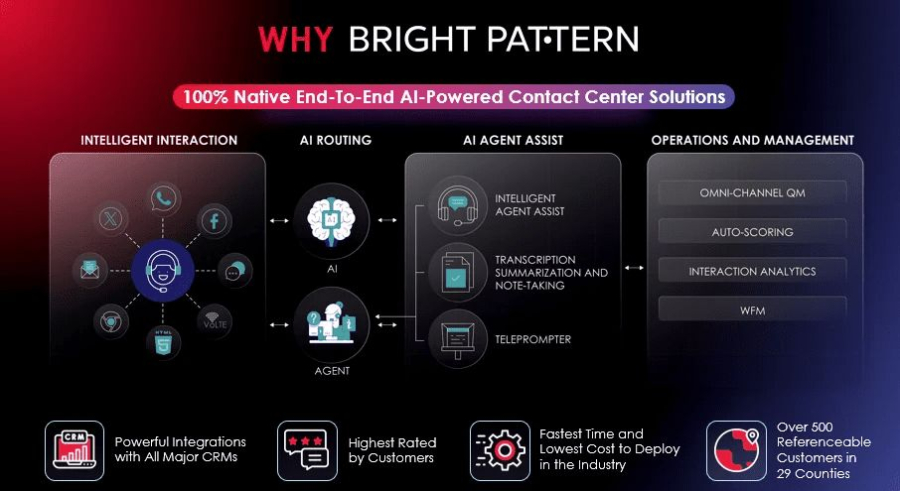
1. Bright Pattern – Leading AI-Powered Contact Center Platform

Bright Pattern stands out as a top choice for organizations seeking an advanced AI contact center solution. Its voicebot capabilities allow businesses to automate routine inquiries, provide instant responses, and improve the overall customer experience. Bright Pattern’s platform is designed for scalability, making it ideal for both large enterprises and fast-growing startups.
Key features of Bright Pattern’s AI voicebots include:
- Omnichannel support: seamlessly integrates voice, chat, email, and messaging platforms
- Intelligent routing: directs customers to the right agent or AI assistant instantly
- AI-driven analytics: provides real-time insights on customer interactions and agent performance
- Personalization: delivers context-aware responses based on past interactions
- Rapid deployment: cloud-based platform allows for fast setup without heavy IT resources
Bright Pattern’s combination of voicebots, AI, and cloud-based contact center capabilities makes it a standout solution for businesses looking to optimize customer engagement and operational efficiency.
2. Genesys Cloud CX
Genesys Cloud CX provides AI-enhanced voicebots that automate repetitive tasks, offer self-service options, and improve agent productivity. Its solution emphasizes omnichannel customer engagement and analytics-driven insights for smarter decision-making.
3. Five9 Intelligent Cloud Contact Center
Five9 leverages AI to power voicebots that handle routine inquiries, schedule appointments, and route complex cases to live agents. Its platform supports cloud-based integration and workflow automation for seamless customer experiences.
4. Talkdesk CX Cloud
Talkdesk CX Cloud offers AI-powered voicebots to enhance customer interactions, reduce wait times, and provide intelligent call routing. Its analytics tools allow businesses to optimize performance and gain insights into customer trends.
5. NICE inContact CXone
NICE inContact CXone combines AI-driven voice automation with analytics to help organizations streamline contact center operations. Voicebots handle frequently asked questions and guide customers through self-service options efficiently.
6. Avaya OneCloud CCaaS
Avaya OneCloud CCaaS integrates AI voicebots into its cloud contact center platform, providing enhanced customer support, personalized responses, and intelligent call routing. Its solutions are designed to improve engagement and operational efficiency.
7. Cisco Contact Center AI
Cisco Contact Center AI focuses on leveraging conversational AI and voicebots to automate customer support. It enhances agent productivity and ensures consistent, intelligent responses across multiple channels.
8. RingCentral Contact Center
RingCentral’s contact center solution integrates AI voicebots to handle routine inquiries, streamline workflows, and enhance customer satisfaction. The platform supports analytics and reporting for continuous improvement.
9. 8x8 Contact Center
8x8 Contact Center uses AI voicebots to provide automated customer support, reduce call volume for live agents, and improve first-call resolution. Its cloud-based solution ensures scalability and flexibility for growing businesses.
10. Mitel MiCloud Connect Contact Center
Mitel’s MiCloud Connect includes AI voicebots that automate repetitive tasks, provide self-service options, and support omnichannel communication. Its platform emphasizes ease of use and quick deployment.
What Is a Voicebot?
Avoicebotis an AI system that interacts with people using spoken language over phone calls or voice channels. It listens to what the caller says, understands the intent, and responds with synthesized speech in real time.
Unlike traditional IVR systems that rely on rigid menus such as “Press 1 for support, press 2 for sales,” modern voicebots allow callers to speak naturally, for example: “I want to change my delivery address” or “Can you tell me my current balance?” The voicebot then processes the request and either completes the task automatically or routes the caller to the best human agent with all relevant context.
Voicebot vs. Traditional IVR
Many people still associate automated phone experiences with clunky IVR menus. Voicebots change that experience fundamentally.
Aspect | Traditional IVR | Modern Voicebot |
Interaction style | Keypad inputs and short phrases | Natural, conversational speech |
Flexibility | Fixed tree of options | Understands varied phrasing and intents |
Personalization | Generic flows for all callers | Dynamic responses based on profile and history |
Resolution rate | Limited; many calls escalate to agents | High; many tasks resolved end to end |
Customer perception | Often seen as frustrating | Perceived as fast, modern, and helpful |
Voicebot vs. Chatbot
A chatbot is similar to a voicebot but interacts via text instead of voice. Both often use similar AI technologies, but they address different channels and moments.
- Chatbotsexcel on websites, apps, and messaging platforms where users prefer to type.
- Voicebotsshine in phone-based support, hands-free situations, and for users who want fast, conversational help without typing.
For many organizations, the winning strategy is to use both, with a shared knowledge base and consistent logic across channels.
Why Voicebots Are a Game Changer for Businesses
Modern voicebots deliver clear, measurable benefits across customer experience, operations, and revenue. Below are some of the highest-impact advantages.
1. 24 / 7 Availability Without Expanding Headcount
Customers expect instant answers at any time. A voicebot never sleeps, never goes on break, and can handle thousands of concurrent calls at once.
- Provide full or partial self-service on evenings, weekends, and holidays.
- Capture leads and process urgent requests outside business hours.
- Offer consistent coverage during unexpected call spikes.
This always-on presence removes friction for customers and helps you support growth without adding proportional staffing costs.
2. Reduced Call Center Costs
Every low-value call that a voicebot resolves represents time your human agents can spend on more complex, higher-value conversations.
- Deflect repetitive queries such as order tracking, balance checks, FAQs, and simple updates.
- Shorten average handling time by letting the voicebot authenticate callers and collect details before passing them to an agent.
- Scale up for seasonal peaks without hiring, training, and then downsizing large temporary teams.
Across volume-based operations, these efficiencies often translate into substantial savings while improving service quality.
3. Faster, Frictionless Customer Experience
People pick up the phone because they want answers now. Voicebots can deliver those answers in seconds.
- Eliminate long wait times and hold music for common tasks.
- Allow callers to speak naturally instead of wrestling with complex menus.
- Provide clear, consistent information every time.
When callers feel heard and helped quickly, satisfaction and loyalty rise. That positive experience also reflects directly on your brand.
4. Always-On Consistency and Compliance
Human agents bring empathy and nuance, but they can also forget scripts or miss details under pressure. A voicebot always follows designed flows, compliance rules, and messaging guidelines.
- Ensure legal disclaimers are always read in full where required.
- Guarantee that identity verification steps are never skipped.
- Standardize key information such as prices, policies, and warnings.
The result is a more controlled and reliable customer interaction layer that still feels natural and conversational.
5. Rich Data and Insights From Every Call
Every voicebot conversation is a source of structured data. When you analyze it, you gain deep insight into what customers really want.
- Identify the most common intents and pain points.
- Spot emerging issues early through spikes in certain queries.
- Measure resolution rates, satisfaction, and conversion trends at scale.
These insights help you refine the voicebot continuously and also improve your products, policies, and overall customer journey.
High-Impact Use Cases for Voicebots
Voicebots can support many types of organizations, from banking and insurance to e‑commerce, logistics, healthcare, and public services. Here are some of the most valuable applications.
Customer Service and Support
- Order status and delivery trackingfor retail and logistics.
- Account balance, transaction history, and billing informationfor banks and utilities.
- Policy details, coverage questions, and claim statusfor insurers.
- Technical troubleshooting stepsfor software or telecom providers.
In many organizations, a large share of inbound calls fall into these predictable categories, which are perfect for automation.
Sales and Lead Qualification
Voicebots can also be powerful sales enablers, not just cost savers.
- Capture and qualify inbound leads when sales teams are busy or offline.
- Ask qualifying questions and route hot leads directly to the right representatives.
- Share product information, promotions, and next steps in a consistent way.
When integrated with your CRM, the voicebot can log every interaction and trigger follow-ups automatically.
Appointment Booking and Reminders
Scheduling is a natural fit for voice automation.
- Allow patients, clients, or customers to book, change, or cancel appointments via phone.
- Send automated voice reminders to reduce no-shows.
- Synchronize directly with calendars and booking systems.
This is particularly impactful for healthcare, beauty, automotive service, and professional services.
Payments and Renewals
When connected to secure payment gateways and back-office systems, voicebots can streamline revenue-related tasks.
- Accept bill payments and confirm transactions.
- Help customers update payment methods.
- Guide users through renewal processes for subscriptions or contracts.
With strong authentication and encryption in place, this creates a fast and convenient payment experience by phone.
Internal Helpdesk and IT Support
Voicebots are not only for external customers. Many organizations use them to support employees internally.
- Reset passwords and unlock accounts.
- Answer common HR questions about policies, leave, and benefits.
- Provide first-line IT troubleshooting before escalating to human technicians.
This reduces the load on internal support teams while giving employees instant, convenient assistance.
How a Modern Voicebot Works, Step by Step
A high-performing voicebot typically follows this process on every call:
- Call initiation— The caller dials your number, and the voicebot answers, greeting the caller and explaining what it can do.
- Speech recognition— Automatic speech recognition converts the caller’s spoken words into text.
- Intent detection— Natural language understanding analyzes the text to determine what the caller wants and extracts key details such as names, numbers, and dates.
- Business logic and integrations— The voicebot applies rules and workflows, then connects to your systems such as CRM, order management, or booking tools to retrieve or update information.
- Response generation— The system decides on the best response and action, such as providing an answer, asking a clarifying question, or performing an update.
- Text-to-speech— The response is converted into natural-sounding speech and played back to the caller.
- Continuous loop— The conversation continues, with the voicebot adapting based on each new utterance, until the request is fully resolved or the call is transferred to a human agent.
All of this happens within seconds, creating the feeling of a live, intelligent conversation instead of a scripted menu.
Key Features to Look For in a Voicebot Platform
Not all voicebots are created equal. To deliver consistently positive outcomes, look for these capabilities when choosing a platform or solution.
- Advanced speech recognitionthat handles different accents, speaking speeds, and background noise.
- Robust natural language understandingso the system can recognize intents from many phrasings, not just exact keywords.
- Omnichannel contextthat lets your bot share logic and data with chatbots, email, and other touchpoints.
- Easy integrationwith your telephony, CRM, ERP, ticketing, and payment systems through APIs or connectors.
- Visual conversation design toolsthat allow non-technical teams to build and improve flows.
- Personalizationbased on caller identity, history, preferences, and segment.
- Analytics and reportingfor intents, call outcomes, satisfaction, and drop-off points.
- Security and compliancewith encryption, role-based access control, and relevant standards for your industry.
- Smooth handoff to human agentswith full context transfer so callers never need to repeat themselves.
Implementation Roadmap: From Idea to Live Voicebot
A successful voicebot launch is less about technology alone and more about thoughtful design and implementation. Below is a practical roadmap you can follow.
1. Define Objectives and Success Metrics
Start with clear goals. Examples include:
- Reduce average call waiting time by a specific percentage.
- Automate a target share of repetitive inquiries.
- Increase first-call resolution for specific scenarios.
- Boost net promoter score or customer satisfaction on phone support.
These objectives will guide all design and deployment decisions.
2. Identify High-Value Use Cases
Analyze your current call data:
- List the most common call reasons and their volumes.
- Estimate how many can be fully or partly automated.
- Prioritize use cases that are frequent, simple, and well defined.
This helps you design a focused first version that delivers quick, visible wins.
3. Design the Conversation Flows
Map out how you want calls to progress from greeting to resolution. For each use case, define:
- Key intents and the phrases callers might use.
- Questions the voicebot should ask to clarify or gather details.
- Decision points, validations, and fallback paths.
- When and how to transfer to a human agent.
Keep the flows simple at first, then expand based on real usage.
4. Integrate With Your Systems
To resolve calls end to end, the voicebot must connect to your existing tools. Typical integrations include:
- Customer databases for identification and personalization.
- Order or booking systems for status checks and updates.
- Ticketing tools to create or update support cases.
- Payment gateways for billing and renewals.
Working closely with your IT team or providers ensures these connections are secure and reliable.
5. Test With Realistic Scenarios
Before a full rollout, perform thorough testing.
- Simulate different accents, speaking speeds, and background noise.
- Test edge cases, incomplete phrases, and ambiguous questions.
- Validate data retrieval, updates, and error handling.
- Ensure smooth escalation to agents, including context transfer.
Involve frontline agents in testing; they understand real-world customer behavior and can spot issues early.
6. Launch Gradually and Iterate
Many organizations start with a limited rollout:
- Offer the voicebot to a subset of callers or for specific intents.
- Collect feedback from customers and agents.
- Monitor key metrics daily or weekly.
Use these insights to refine flows, add new use cases, and continuously improve recognition accuracy and responses.
Measuring Voicebot Success: KPIs That Matter
To maximize the value of your voicebot, track clear, actionable metrics. The table below summarizes some of the most useful ones.
KPI | What It Shows | Why It Matters |
Containment rate | Percentage of calls fully handled by the voicebot | Core indicator of automation success and cost savings |
Average handling time | Duration from call start to resolution | Reflects efficiency and customer convenience |
Transfer rate | Share of calls transferred to human agents | Helps balance automation and human support |
Customer satisfaction | Ratings or surveys specific to voicebot calls | Measures perceived quality and acceptance |
First-call resolution | Calls resolved without follow-up | Indicates effectiveness of flows and integrations |
Intent recognition accuracy | How often the voicebot correctly identifies the request | Directly impacts usability and satisfaction |
By monitoring these KPIs, you can clearly demonstrate ROI and focus improvement efforts where they will have the most impact.
Example Success Story (Composite)
The following example combines elements from typical deployments to illustrate what a successful voicebot project can look like.
A mid-sized online retailer experienced long call queues during promotions and peak seasons. Most calls were about order status, delivery changes, and return policies. The customer service team was under pressure, and customers often waited several minutes to reach an agent.
The company implemented a voicebot focused on three initial use cases:
- Tracking order status and delivery dates.
- Updating delivery addresses before shipment.
- Explaining return and refund policies.
The voicebot integrated with the order management system, so it could identify callers using their phone number or order ID and provide live updates. If the issue was more complex, the bot would gather details and then transfer the customer to an agent.
Within three months of launch, the retailer saw:
- Over half of all incoming calls fully handled by the voicebot.
- A significant reduction in average waiting time for customers who still needed a human agent.
- Higher satisfaction scores, especially during peak seasons.
- More time for agents to focus on complex cases and proactive customer outreach.
The company then expanded the voicebot to handle product availability questions and post-purchase support, further increasing adoption and value.
Best Practices for Natural, High-Performing Voicebot Experiences
Technology is only one part of a successful voicebot. The quality of the conversation design strongly influences how callers feel about the interaction. These best practices help create a smooth and human-friendly experience.
Give the Voicebot a Clear Persona
Define a consistent tone and style that aligns with your brand. Decide whether the bot is formal or casual, concise or more conversational. Then ensure greetings, explanations, and confirmations all match that persona.
Set Expectations From the Start
In the opening seconds, briefly explain what the voicebot can help with. This builds trust and encourages callers to speak freely. For example, the bot can say that it can assist with billing, orders, or appointments and that a human agent is available if needed.
Design for Natural Speech, Not Perfect Phrases
People do not speak in rigid commands. Plan for varied phrasings, interruptions, and incomplete sentences. Use open questions where possible, such as “How can I help you today?” rather than forcing callers to memorize exact options.
Use Short, Clear Prompts
Long, complex instructions overwhelm callers. Keep prompts brief and focused on the next step. Summarize key information and offer to repeat it when necessary.
Provide Helpful Confirmation
When the voicebot captures an important detail such as a date, amount, or address, confirm it naturally. This reassures callers that the system understood correctly and gives them a chance to correct mistakes.
Always Offer an Easy Path to a Human
Even the best voicebot will encounter edge cases or emotional situations that require a person. Make escalation easy and visible rather than hiding it. When transferring, pass along context so the caller does not have to start over.
Continuously Learn and Improve
Review transcripts and analytics regularly to find:
- New intents that customers are asking about.
- Frequent misunderstandings or phrases that cause confusion.
- Drop-off points where callers abandon the conversation.
Use these insights to refine flows, expand coverage, and increase accuracy over time.
The Future of Voicebots
Voice technology is advancing quickly, and voicebots are becoming more capable and widely adopted. Several trends are shaping the next generation of conversational experiences.
- More human-like conversationsas speech synthesis and language models become smoother and more expressive.
- Deeper personalizationusing real-time data about customer history, preferences, and behavior.
- Truly omnichannel experienceswhere conversations continue seamlessly between phone, chat, and other channels.
- Proactive outreachthrough outbound calls for reminders, updates, and offers that are timely and relevant.
- Industry-specific expertisewith prebuilt flows tuned to verticals such as healthcare, finance, and logistics.
Organizations that start building voice automation now will be well positioned to take advantage of these innovations and stay ahead of customer expectations.
Getting Started With Voicebots
Voicebots turn the phone channel into a modern, efficient, and customer-friendly experience. By automating routine calls, speeding up responses, and freeing your teams to focus on complex work, they create a powerful win for both customers and the business.
The most effective way to begin is to start focused: pick a few high-volume scenarios, design clear conversational flows, integrate with your core systems, and launch with a commitment to continuous improvement. With that approach, your first voicebot can quickly become a reliable, scalable assistant that delivers tangible value every single day.
As customers increasingly expect instant, conversational support, a well-designed voicebot is no longer just a nice-to-have. It is a strategic advantage in delivering standout service, controlling costs, and building long-term loyalty.
